
Understanding Tides in Pembrokeshire | Surf Lessons, Beach Safety & Coastal Adventure
Learn how tides affect surfing, paddle boarding, kayaking and coasteering in Pembrokeshire. Understanding high tide, low tide, spring tides, neap tides and tidal range helps you choose safer conditions and get more from your time in the water.
Outer Reef uses local tide knowledge every day when planning surf lessons, school sessions, family activities and guided watersports across Pembrokeshire.
Why Understanding Tides Is Important for Surfing in Pembrokeshire
Tides are the rise and fall of the sea caused mainly by the gravitational pull of the moon and, to a lesser extent, the sun. Around Pembrokeshire, tide height and tidal movement can change the shape of a beach, the strength of currents, the position of rocks and the quality of the waves.
For surfers, this matters because the same beach can feel very different at low tide, mid tide and high tide. One tide may create gentle beginner-friendly waves, while another may produce stronger currents, steeper waves or exposed hazards.
High Tide, Low Tide, Spring Tides and Neap Tides
Here are the main tide terms every surfer, paddler and coastal adventurer should understand.
High Tide
High tide is when the sea reaches one of its highest points. Some beaches become smaller, waves may break closer to shore and certain hazards may be covered.
Low Tide
Low tide is when the sea is at one of its lowest points. More beach may be exposed, along with rocks, reefs, channels and sandbanks.
Spring Tides
Spring tides happen around the new moon and full moon. They usually create a larger tidal range, with higher high tides and lower low tides.
Neap Tides
Neap tides happen around the half moon. They usually create a smaller tidal range, with less difference between high and low water.
How Tides Change Surf Lessons and Beach Safety
Outer Reef instructors assess tide, swell, wind and beach conditions before every session. This helps us choose suitable areas for beginner surf lessons, family surfing, schools and improver coaching.
Wave Shape
The tide can change how waves break. Some beaches work better at mid tide, while others may be too steep, too shallow or too powerful at certain stages.
Rip Currents
Large tidal range, swell and beach shape can contribute to stronger currents. This is one reason local knowledge and supervised lessons are so valuable.
Beach Access
Tides can affect where groups meet, how much beach is available, and which hazards are visible. Always check local information before entering the water.
Surf Lessons, Tide Knowledge and Water Confidence
Our lessons are not just about standing up on a board. We help you understand the beach, waves, tide, currents, equipment and basic safety so you can become more confident in the sea.
Beginner Surf Lessons
Start surfing safely with local coaches.
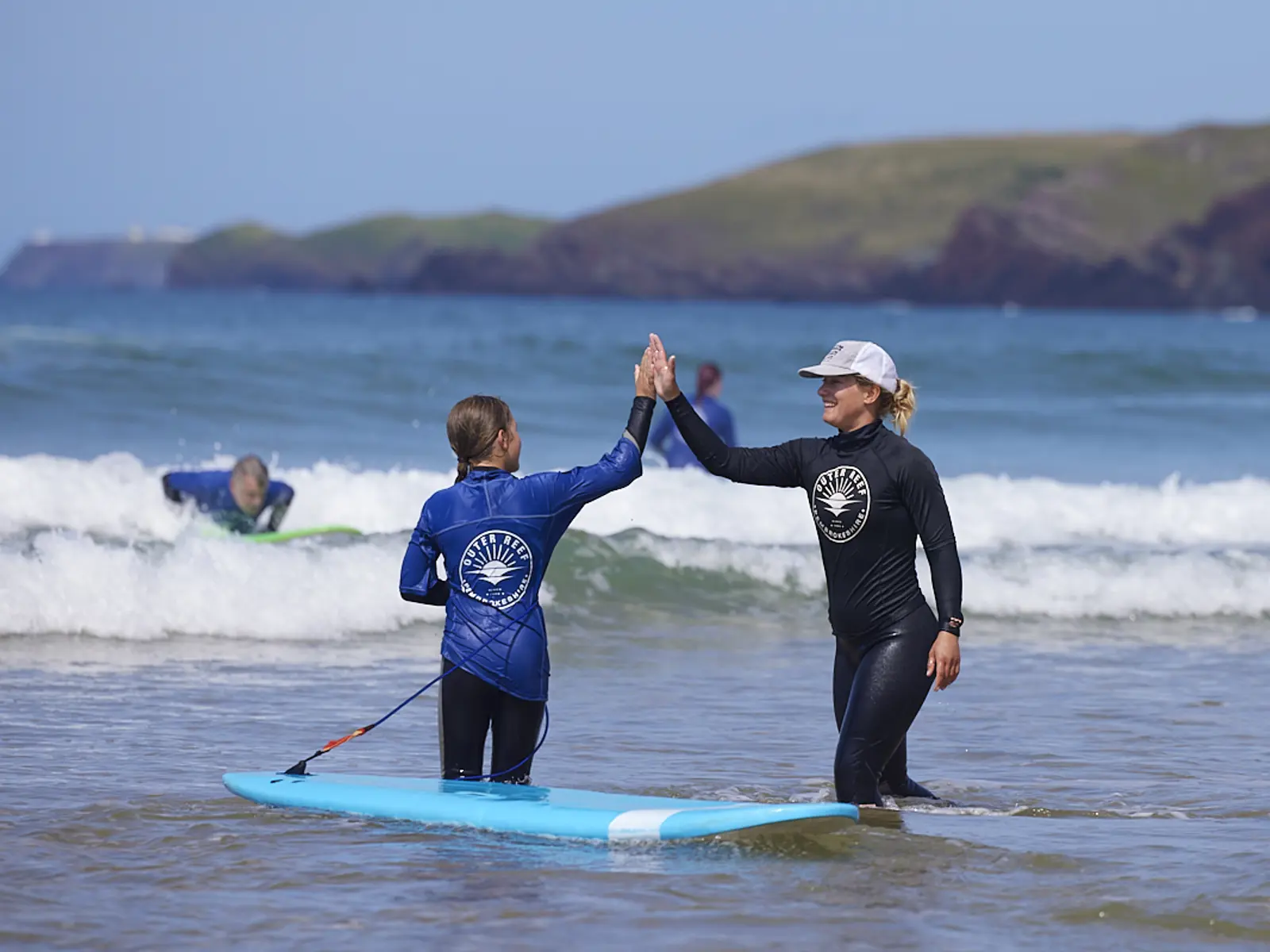
Start Surfing
Improver Coaching
Learn to read waves and choose better conditions.
Improve Surfing
Private Family Surfing
Personal coaching for families and groups.
Family Lessons
Surf Shop
Boards, wetsuits, changing robes and surf kit.
Visit ShopTides Across Freshwater West, Manorbier, Tenby and Stackpole Quay
Every Pembrokeshire location behaves differently. Tide, swell direction, wind and local geography all affect whether a beach is suitable for surfing, paddle boarding, kayaking or coasteering on a given day.


Surf Lessons, Tide Safety, Equipment Hire and Adventure Activities
Use these internal links to move between our most useful surf lesson, watersports, equipment and location pages.
Understanding Tides for Surf Lessons FAQs
Why do tides matter for surf lessons?
Tides affect wave shape, water depth, beach space, currents and hazards. This is why Outer Reef checks the tide and conditions before surf lessons and coastal activity sessions.
Are spring tides dangerous?
Spring tides are not automatically dangerous, but they usually create a larger tidal range. This can mean stronger currents, more exposed rocks at low tide and less beach space at high tide.
What is the best tide for beginner surfing?
The best tide depends on the beach, swell, wind and sandbanks. For beginners, the safest option is to book a lesson with qualified local instructors who understand the conditions.
How often do tides change?
Many UK locations experience two high tides and two low tides each day, with tide times shifting each day. Local tide tables should always be checked before entering the water.
Do Outer Reef lessons include safety information?
Yes. Surf lessons include guidance on equipment, beach safety, basic surf awareness and how conditions affect the session.
Can I buy or hire surf equipment?
Yes. Outer Reef offers equipment hire and also links to the Outer Reef Surf Store for wetsuits, boards, changing robes and surf accessories.

Book Surf Lessons in Pembrokeshire with Outer Reef
Learn to surf with experienced local instructors who understand Pembrokeshire tides, beaches, swell and safety. Book your surf lesson online, explore our locations or visit the surf shop before your next adventure.
UNDERSTANDING THE TIDES | OUTER REEF SURF SCHOOL
it's important to understand the effects of the moon and sun on tides since they play a significant role in shaping the surf conditions. Let's dive into understanding tides and how the moon and sun influence them.
Tides are the movements of large bodies of water within the oceans and seas of the world caused by a gravitational pull from the sun and moon. All large bodies of water have the potential of a "tide" but it is most noticeable on the oceans, where marked differences can be seen. Tides are essentially Vertical and Horizontal movements of the oceans.
CAUSES OF TIDES IN PEMBROKESHIRE
The movement of water, that we call tide, is caused by the gravitational pull of the moon, and to a lesser extent, the sun, and by the rotation of the earth. The pattern can best be described in three stages; daily, monthly and annual cycles.
N.B. For the purpose of presenting the model below, ignore the effect of land and consider the earth completely covered in water.
DAILY TIDE MOVEMENT
The earth takes 24 hours to complete one revolution and in any one day, the waters of the earth will be "affected" by the presence of the sun and moon. On one side of the earth, the waters will feel a gravitational pull from the moon and to a lesser extent, the sun. However the earth itself is fixed in its position and orbit. The only movable constituents are the seas and oceans. This results in the water being pulled towards the moon / sun which forms a "bulge" on one side of the earth and a High Water. To compensate for the water being pulled towards the moon forming a tide, another bulge must form on the other side of the earth (Newtons second law - To every action there is an equal and opposite reaction). Thus giving us two high tides and two low .
N.B. There are a variety of explanations for the existence of the compensational bulge, generally equal in merit!
SPRING TIDES
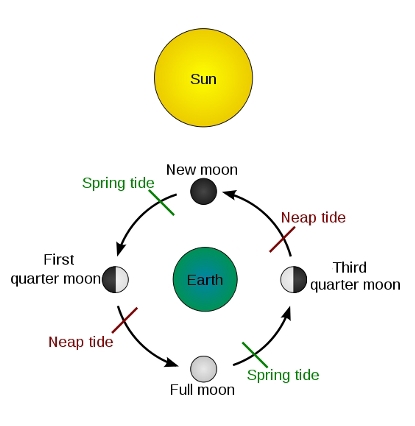
When the earth, sun and moon are in-line the gravitational "pull" is at its greatest and in a straight line, resulting in the largest volume of water being pulled, creating a Spring Tide.
Spring tides produce high, high waters and low, low waters. i.e. They have a large Tidal Range ( often twice the range of a neap tide). The dates of Spring Tides correspond with both the New and Full Moon, in fact the greatest ranges (distances between heights of high and low) are appreciated 2 - 3 days after the new or full moon. The New and Full Moons occur when the earth, moon and sun are in line.
NEAP TIDES
When the relative positions of the moon and sun are at right angles to each other, with the earth in the middle, Neap Tides occur. This combination produces the smallest tidal range (generally half the range of spring tides) with a low, high water and a high, low water. Looking into the sky, one might see a half moon.
Generally in any one 24 hour period, any one place will experience at least 2 High tides and 2 Low tides, with approximately 12 hours between successive high tides therefore six hours between any high tide or low tide. These are known as Semi -Diurnal tides.
However, as tides follow the moons rotation around the earth, there is actually 24 hours and 50 minutes between daily tides. Therefore the times of high and low water will be approximately 50 minutes later each day.
e.g. if high water is a 11.90 hours today, it will be at approx. 12.20 hrs tomorrow.
- Some areas of the world do not necessarily experience semi-diurnal tides. Diurnal (once daily) or mixed (semi-diurnal but variable in the heights of high and low water) tides are common in many places.
- The shape of the sea bottom or land masses, proximity to a large river and other factors can all affect the tides.
MONTHLY TIDES
During the period of a lunar month, some 28 days, the moon rotates around the earth in an elliptical orbit causing its gravitational attraction to vary. Consequently this has an affect on the tides as the strength of the moon’s pull changes.
The moon’s pull increases as its orbit takes it closer to the Earth and vice-versa. In each 28 day period we experience 4 complete tide cycles that is 2 high High tides and 2 low Low tides.
ANNUAL MOVEMENT
Over a period of a lunar year, the moons elliptical orbiting pattern around the earth causes it to be closer at certain times of the year (Spring and Autumn). At such times the moons gravitational attraction will be stronger, affecting tide and causing an even greater amount of water to be moved. On these occasions there will be an even larger range of Spring tides.
Termed as the Equinoctial Spring Tides they occur on or about 21 March and 21 September.
When the moon is furthest away, the forces are least and this occurs around 21 December and 21 June at the Solstices.
TIDAL RANGE
This refers to the vertical movement of water. The range is measurable as the actual distance between the heights of any high and low water. e.g. If high water is described as being 4.2 metres and low water 1.2 metres, the range will be 3 metres, that is the actual height moved.
Tide heights are measured above a notional point known as Chart Datum, normally corresponding to the LAT, Lowest Astronomical Tide. This is the lowest possible level that the sea may fall to in any one area although it is highly unlikely that it would.
The amount of vertical movement of water will vary from place to place and from day to day. Information about the vertical movement at any given place is available in "Tide Tables" for the location.
Tidal streams, and to a lesser extent vertical movement of the tide, can be affected by the wind. e.g. A strong onshore wind will make a high tide even higher by physically pushing water into the shore. A low pressure system will have the same effect (by reducing the atmospheric pressure on the sea) and the two combined will exert an even greater force. Both of these effects are best illustrated in bays and estuaries such as the Severn Estuary (Between Wales and England) where a strong South Westerly wind and deep depression greatly increases the height of the tidal bore that runs up the river Severn.
Generally the tide does not rise and fall at the same rate, near low tide and high tide the rate slows down and around mid tide the rate is greatest. In some areas the tides rises 3 times as fast around mid tide as compared with when it first starts to rise or fall.
Local geographical features, e.g. offshore islands, reefs, river mouths etc. may cause localised tidal anomalies. These may include large differences between the time it takes for the tide to come in and for it to go out.
PEMBROKESHIRE TIDE TABLES
When planning a surfing lesson in Pembrokeshire it is important to know how the tides will affect the surf and the safety of a particular beach. Spring tides can help produce dangerous rip currents even when the surf is very small because the tidal range of spring tides is large, rocks and other dangers may be uncovered as the tide recedes. Also near to high tide the waves may dump onto a steep sand bank making it unsuitable for beginners. Tide Tables are produced in a tabular form showing the times and heights of high and low water for a specific place. For each day of the month the times of each high and low tide are given as well as their height.
UNDERSTANDING THE TIDES IN PEMBROKESHIRE
SURF LESSON IN PEMBROKESHIRE FOR ALL AGES & ABILITIES
SURF LESSONS | UNDERSTANDING THE TIDES IN PEMBROKESHIRE
Learn to surf with us!


EQUIPMENT HIRE?
Surf Equipment Hire in Pembrokeshire. Foamie’s are fantastic boards, the perfect boards for learning the foundations of surfing.Foam boards are very buoyant, with lots of volume and a soft construction.

Follow us and stay in the loop!
Real photos from the water — surf lessons, coasteering, kayaking and the odd Pembrokeshire sunset.
Follow @outerreef →Tripadvisor Travellers’ Choice Award winner
Recognised by Tripadvisor for consistently excellent reviews across surf lessons, coasteering, paddle boarding and kayaking adventures.